The tenant scans their unit once at move-in. Months later they type “ski boots” into their phone instead of opening twenty boxes. You bill it like the smart lock: one more tenant-paid line item on the rent, and you keep the majority.
You will be talking to the founder, not a sales team.
This unit was about to go delinquent. One walkthrough made every box a named, priced, searchable inventory.
Your tenants stack a smart lock fee and a protection plan on the rent today. ItemMap is the same motion: tenant-paid, monthly, attached as the default at move-in. No hardware. No batteries. No install.
Smart lock
$5.99/mo
Tenant-paid. Attached at move-in. Hardware in every door.
Tenant protection
$9 to $12/mo
Tenant-paid. Attached at move-in. Industry-standard attach rates of 80 to 90%.
ItemMap
A search bar
for the unit
Tenant-paid. Attached at move-in. Zero hardware, and you keep the majority of the fee.
Your staff already attach the lock and the plan at the counter. ItemMap adds one line to that script, and the tenant scans twice: each box as it gets packed, while everything is out and in hand, then one slow sweep of the loaded unit so the big stuff makes the inventory too. Nothing to remember later, ever.
At protection-plan attach rates, 80 to 90% when it is the move-in default, more than double that. Zero capex. Zero staff time past the move-in counter.
One slow walkthrough
A phone is the only equipment
The unit becomes an inventory
Every item named and priced automatically
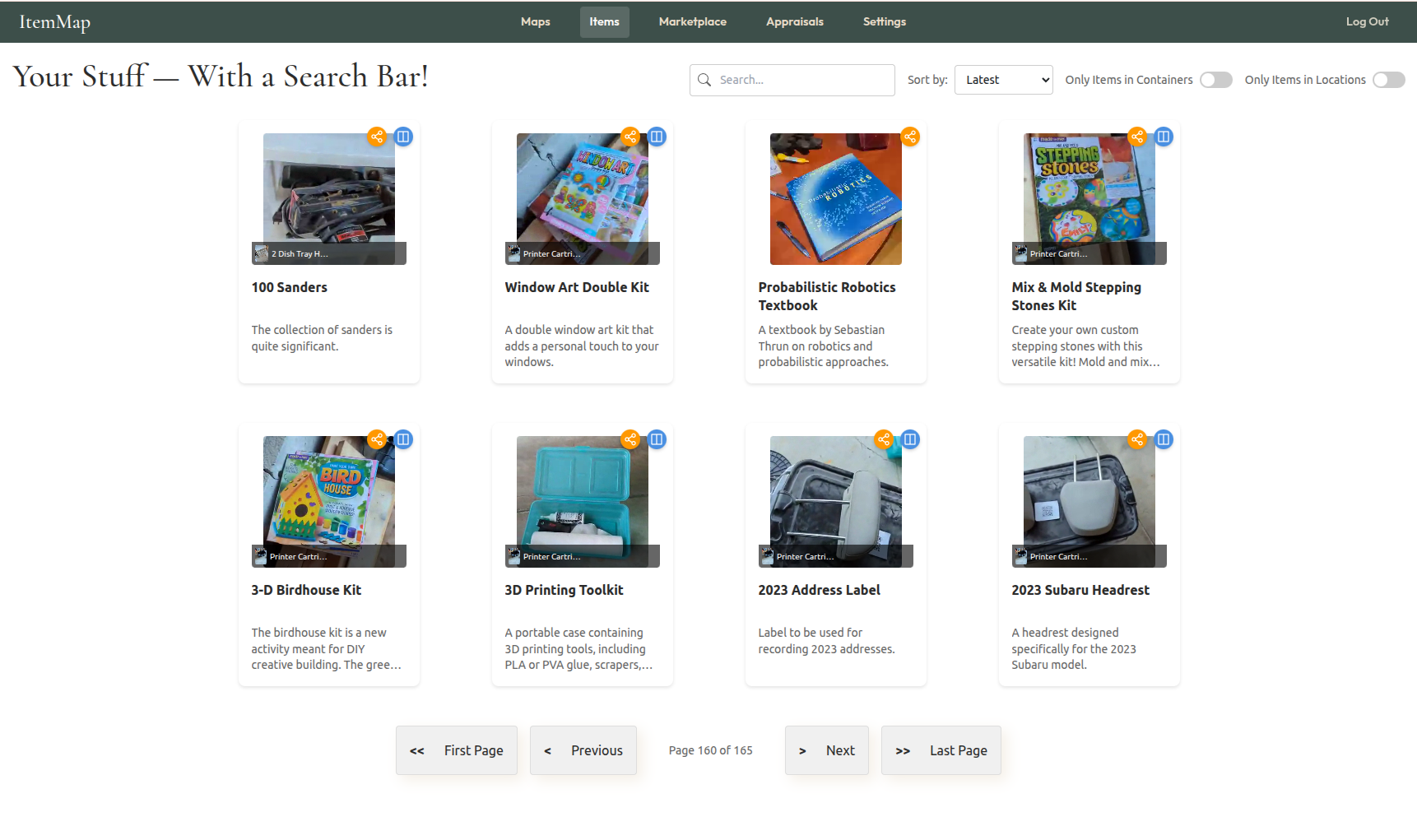
The tenant's unit, one search away.
We bet the other way. The big churn event is the day a tenant decides they are paying for a unit of junk and clears it out wholesale. Named, searchable belongings feel worth keeping, and they are harder to abandon than an anonymous pile. That is why length of stay is the pilot's primary metric. If inventoried tenants do not stay longer, the pilot failed and it cost you nothing.
One scan, at move-in, at the same moment your staff already attach the protection plan and the lock, while every box is out and in hand. Nothing is required from the tenant after that day. First-scan completion is a tracked pilot metric, so you will see the number, not a promise.
The honest answer: nobody has an inventory-layer number yet, and the pilot exists to measure one on your rent roll rather than in a vendor deck. The nearest precedent is Janus's Nokē Smart Entry case study, which reports about $58 a month of higher rent on 10x10s where smart units became the default. That figure is vendor-reported, and it is locks, not inventory, so treat it as directional: tech-tier units command premiums. We would rather report your number at day 90 than argue about theirs. An inventory also raises what tenants believe their contents are worth, which supports higher protection-plan tiers.
The tenant. Item-level contents are private to them: facility staff never see inside a unit's inventory without the tenant's consent, and export is committed to stay free, so a tenant's inventory is theirs to take anywhere. That boundary protects you as much as it protects them; nobody can claim your team knew what was in a unit during a lien sale or a dispute. The operator's side of the deal is everything above the content level: attach rate, first-scan completion, and length of stay against your baseline, reported at day 90 and, in any event, yours to keep.
Walk us through one facility. If the numbers do not work on your units, you will know it in an afternoon.
or write tim@itemmap.app directly
ItemMap is built by Tim Winter: employee #36 at DataRobot, Director of Engineering through its $6B valuation. He builds ItemMap's computer-vision pipeline himself. The system reconstructs a unit in 3D from a phone camera. That is the last you will hear about the technology.

